
LET ME TELL YOU A STORY….
The boy who created computer games
Once upon a time there was a boy, who created computer games for fun. When he went to university he created a computer programme that allowed people to create online personas of themselves with profiles and photos. On this platform you could be whoever you wanted to be and become friends with lots of people so that you looked really popular. He named his computer programme Facebook. Within 13 years the boy, who created computer games, for fun, had become the fifth richest man in the world. His Facebook platform was so popular that it spread to other countries including a small land named the United Kingdom.
 The man who created a smart device
During that time another man created a device that you could hold in your hand and talk to. It was called a smart phone. It was so smart that it could monopolise someone’s attention so that they paid more attention to the device than the person sitting next to them. People became addicted to using the smart phone device and they also became addicted to looking at the Facebook platform on the device. By the year 2017 over 32.5 million people (source statista.com) in the Kingdom were using the platform and over 80% of people had a smart phone device (source deloitte.co.uk). The platform and the device had changed the way people communicated. Businesses and retailers began to change their marketing strategies and talked about ‘social shopping, with mobile the unifying platform for interacting with customers,’ (Sergio Bucher, CEO, Debenhams, source BBC news 20/4/17)
Life in the social world
Now the people in the Kingdom used the social platform for a variety of reasons. They liked to connect with their friends and family all over the world. They also liked to see what other people were doing for fear of missing out. Sometimes they used the social platform to show off or tell everyone what they thought about something. This would often make themselves feel better as it made them feel very clever. However, sometimes other people thought it was actually quite annoying.
Often they were just bored, had some time to kill or wanted to escape from real life, which was often more monotonous than life in the social world. They usually found that there was something on this social platform that they viewed from the smart device that would amuse or entertain them.
The business people
Now the business people began to realise that all the people in the Kingdom were spending a lot of time on the social platform (almost an hour a day on average!) and they were no longer looking up at the beautiful leaflets, adverts and T.V commercials that the business people were spending lots of money creating for them. They realised to get the attention of the people in the land they had to go into the social world, connect with them and entertain them on the social platform. They had to get the people to like them in the social world but this was sometimes really difficult.
Storytelling
 The really clever marketing people discovered that a great way to connect with the people was to tell them a story. Story telling was one of the oldest forms of communication. Long before people could read or write history was handed down from generation to generation through stories. Some tribes in remote parts of Asia and Africa where literacy is poor still communicate in this way. They also realised that if they told a story particularly well using pictures and videos the people often shared the stories with their friends. This made the marketing people really happy as it made lots of people like them.
The beautiful land of Wales
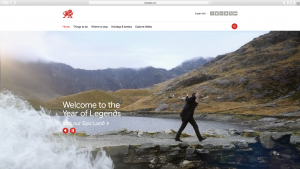
Now one such example of this was the country of Wales. The Welsh government wanted more people to visit the beautiful land of Wales. So they created an advert, which told a story and showed the advert on T.V, Facebook and YouTube. The advert was about Welsh legends and the campaign was called #Find your epic. They also found a handsome Welsh actor named Luke Evans to narrate the story. Amongst a backdrop of rugged Welsh mountains and streams Luke tells the story of Welsh legends, “Heroes of wild Wales, epic legends living in storytellers’ tales…You become the legend and teller of the tales when you find your epic deep in the soul of Wales.”
The people like the advert
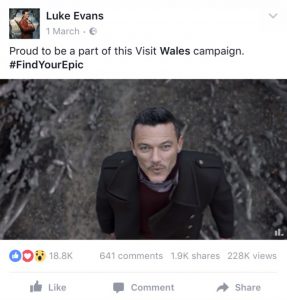 Now the people on the social platform really liked this advert. The advert entertained them, in fact it was enthralling. It was total escapism and they watched it again and again. They found it inspired them to want to have an adventure and be part of the story and visit the land of Wales. They liked it so much that at the time of writing (20th April 17) 228k people had viewed Luke Evans Facebook post featuring the advert, 18.8k liked it, 641 people commented on it and 1.9k people shared it with their friends and perhaps suggested a trip to Wales. Some of them went onto the visitwales.com website where the story was continued. Some of them visited or planned to visit Wales and then posted photos on social platforms using the #Findyourepic. The people were able to experience the story across various touch points and become part of the story themselves. The campaign was a great success.
Declaration from the Prince
Around that time there was a declaration from the Prince of the Kingdom that actually one in four people in the land were suffering with mental health problems and perhaps it would be a good idea if actually people were to talk more about their problems in real life.
This was somewhat ironic considering in the social world everyone’s lives looked so happy.
Meanwhile in San Jose…
Meanwhile in San Jose the Facebook platform began to work on ways to read users thoughts and use artificial intelligence powered augmented reality.
END OF PART ONE…
Would you like to be part of the story?
If you would like to learn more about how you can create your own story please visit our digital marketing page to see how Bright Disposition can help you.
