
This week I’ve been looking at the way in which three popular retailers have used social media marketing to engage their customers with their brands in the run up to Easter.
For many supermarkets Easter is the second biggest event of the year and seasonal aisles this week are full of chocolate eggs, Easter plush, novelties and craft accessories. The Easter holidays give a sales boost to most arts and crafts departments as kids are on school holidays and parents look for craft activities to entertain them. There is also the traditional Easter egg hunt and there is a surge in novelty gifting sales as families buy children alternative Easter gifts to chocolate.
The three retail brands I’m going to look at are Paperchase, Hobbycraft and Smiggle. I have selected these brands as in today’s market place they are all competing with the supermarkets for the Easter spend and so need to differentiate. They do this through product offer and marketing. Social media marketing is becoming increasingly important in building customer loyalty.
All three brands have thousands of followers on Facebook, Instagram, Twitter and Pinterest as follows (figures correct as of 10th April 2017):
| Fan numbers | Paperchase | Hobbycraft | Smiggle |
| 219,787 | 229,746 | 389,842 | |
| 93.1k | 39k | 29k | |
| 31k | 29.2k | 11.8k | |
| 30,177 | 89,262 | 1596 |
Choice of Channel
The first thing to note is how the different customer profiles of each brand will dictate, which social media platforms are most successful for them. For any businesses, when considering, which social media channels to use it’s important to consider your target customer and where they spend their time online. In particular their age will dictate whether they are generation X, Y, or Z. This will give clues as to how they will behave online.
Not surprisingly with their kids and tween customer base Smiggle gets the best results on Instagram for their Easter posts, even though they have more Facebook fans. They have low levels of engagement with their posts on Facebook compared to the other two brands Paperchase and Hobbycraft who will have an older millennial or generation X customer base, who are more likely to use Facebook on a regular basis. I suspect users of the Smiggle Instagram account are more likely to be children and users of the Smiggle Twitter and Facebook accounts are more likely to be their parents! Smiggle and Hobbycraft both do really well on YouTube as well. Smiggle with their Smiggle TV webventures kids cartoons and Hobbycraft with their craft demonstrations.
Interactive content
 One of the best ways to engage consumers with your brand online is to show interactive content. A great example of this is on the Hobbycraft Facebook page. Entitled ‘Hobbycraft shows Wilton Cake Decorating UK.’
Originally shown live on April 6 they show a LIVE demonstration on ‘how to make an Egg Statement Cake in time for Easter!’ This content is original, exciting (because it’s LIVE) and not surprisingly as of the 10th April it had received 4,278 views. It’s also perfect content targeted at the main Hobbycraft customer – a female aged between 25 and 54.
Competitions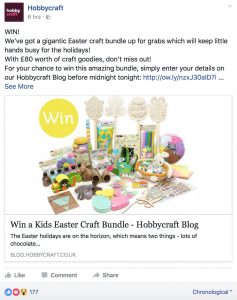
Competitions are all over Facebook for a very good reason, people like winning free stuff and share the competition ads with their friends, extending reach and the probability that those friends will in turn become fans. As there are so many competitions on Facebook, you’ve got to make your competition really stand out now to create a stir online.
Hobbycraft again comes up with the goods with a ‘Win a Kids Easter Craft Bundle.’ They offer a great prize, a large bundle of products (cornucopia!) which advertises Hobbycraft products and creates excitement. Within 6 hours they have received 177 likes, 26 shares and lots of great sentiment through the comments underneath the post.
Brand engagement
Some of the posts are simply aimed at building customer connections with the brand and reinforcing brand values. It’s really important as a brand to have a consistent tone of voice. Paperchase for example uses social media marketing to post lots of quirky or cute statements alongside photos of products, which are equally as quirky or cute. They usually use lifestyle photography to set the scene.
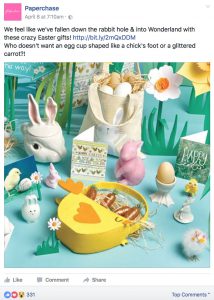
 For example, an image of quirky Easter gifts features the statement ‘We feel like we’ve fallen down the rabbit hole and into Wonderland with these crazy Easter gifts! Who doesn’t want an egg cup shaped like a chick’s foot or a glittered carrot?!;’ This post receives a good level of engagement and 331 likes.
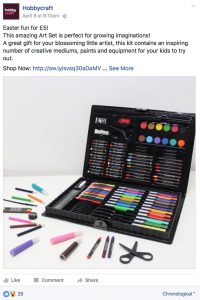
There needs to be an emotional connection in the language and imagery used as can be seen in the Paperchase example or a call to action as can be seen in the competitions. Just posting any old image of a product on your Facebook page with a sales message, doesn’t usually work as well. For example, an image of an Easter art set on the Hobbycraft Facebook page with the comment ‘Easter fun art set for £15,’ gets relatively few likes (only 29) compared to other posts as it is more selling than engaging.
Driving traffic to their website or into store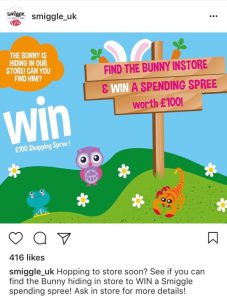
Competitions and pictures on the Hobbycraft Facebook page usually click through to the Hobbycraft blog on their website. This is a common end goal of a social media marketing campaign
– to get customers to browse your website and ultimately buy your products.
Smiggle also features a competition on Instagram to ‘Find the Bunny instore & win a spending spree worth £100!’ Again this is a great example of multichannel retailing and a good way to drive customers into store.
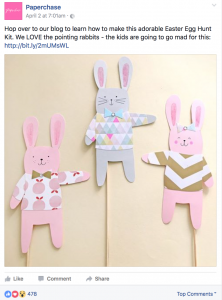 Paperchase feature an image of paper rabbits with the statement ‘Hop over to our blog to learn how to make this adorable Easter Egg Hunt Kit. We LOVE the pointing rabbits – the kids are going to go mad for this.’ Again driving web traffic back to the blog on the Paperchase website.
What can we learn?
All of these retailers will have dedicated social media marketing teams and carefully planned campaigns. However, I am convinced that any business can build a presence on social media with a moderate budget. Effective social media marketing requires you to know who your customer is, have a strategic digital marketing plan (what are we trying to accomplish?) and then a tactical marketing plan to engage customers (how are we going to accomplish this?).
Getting social media marketing right
It’s easy to be present on social media but not so easy to do social media marketing well! I would encourage any brand to get your strategic marketing foundations right before you jump in. Otherwise you are simply throwing paint balls at a white wall. At the end it may look very colourful but you may have completely missed your target!
If you are in the stationery, gifts, arts and crafts industries and would like some creative help with this then please get in touch.
You can find out more about how Bright Disposition can help on our digital marketing page.
