How important are the Back to School colour stereotypes of pink is for girls and blue is for boys?

The summer months are here, school term has ended and retailers have launched the all-important ‘Back to School’ season. Indeed, in the stationery world that I have been so immersed in during my buying career, “BTS” is ‘the’ season – our Christmas, Easter and Mother’s Day rolled into one, the ultimate test of your buying skills.
I recall one particular BTS whilst working as an Assistant Buyer at Paperchase, there was much chatter in the office about an email complaint from a customer, referencing our BTS window scheme. Our archive-sourced retro window images depicting a young girl baking cupcakes swathed in a veil of pink mist, and a boy, looking tough in blue whilst playing with killer sharks, had caused some furore amongst the contributors to popular parent’s website Mumsnet. Paperchase’s controversial response was that the complainant had somewhat missed the irony in the gender stereotypes that had been emblazoned across the front of their flagship store in London. But had they? And does being ironic still play into the hands of the age-old stereotype that pink is for girls and blue is for boys? And is it actually just a lazy money-maker falling back on these stereotypes?
As a buyer, choosing the designs for this big money season was the annual conundrum. “Okay, we know princesses, fairies and unicorns sell for girls, but what do boys like?” the buying team quizzically pondered. It never occurred to us that maybe we were dictating to children what they should like and play with – we were sure that this is what they themselves – and the sales – were telling us. Even today, this seems reaffirmed to me as an Aunty to 3 children under 7 – I watch the two girls playing with their unicorn and fairy toys and proudly announcing their favourite colour as pink, whilst the 2 year old boy throws his dinosaurs around and makes ‘brum-brum’ noises as he drives his toy cars up my arm. What I don’t know is if this is innate, or have they succumbed to subtle (and not-so-subtle) marketing tactics they are unknowingly exposed to?
Paperchase certainly wasn’t the only retailer to plan their product ranges in this way, with clear segregation in colour and design to depict what girls and boys may find appealing (although aside from these particular windows, it was never explicitly stated to the consumer). However, this gender cliché doesn’t always stop at visual appeal.
Let Toys Be Toys
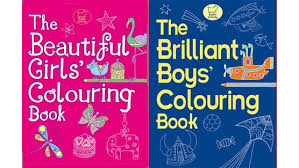 The Let Toys Be Toys campaign has highlighted how much further this can go – and this is what we should be concerned with. Book covers entitled ‘Brilliant Boys’ and ‘Beautiful Girls,’ and dress-up outfits for boys as doctors, girls as beauticians. Research by Let Toys Be Toys shows that adverts promoting toys aimed at boys show them mastering complex equipment and being in control, whilst in female-targeted ads girls are passive and inactive, with an overwhelming emphasis on grooming, appearance and nurturing. The words, activities, and levels of engagement shown all without doubt enter the minds of the young, and potentially shape the way they perceive their own gender expectations or limitations in terms of behaviour, language, and eventually even what studies or career they can aspire to. Both boys and girls are inevitably affected – boys have to be strong and clever, whilst girls have to be pretty and quiet – but who suffers the most long-term I ponder, knowing that less women enter science careers than ever.
A more recent example, take the current Star Wars themed merchandise – hats off to Disney for entitling all their products “for kids,” but where is the film’s female heroine Rey to be seen? 30th down in the search list, that’s where. And what about the little boy dressed as Frozen’s Elsa for the school day, whose mother was berated by another mother for letting him wear the outfit? Here we are, the wise adults, telling children what they should like and who they should be.
Maybe some girls are more predisposed to pink and make-up, whilst some boys are drawn to blue and technical toys, but it seems to me that we should let them decide this for themselves. Of course, to the retailers it’s all about making money, but when we know that it is actually so much more than this, shouldn’t we all be fighting for change? After a targeted campaign on Twitter, Hamleys toy store took the bold step in 2011 of scrapping their separate floors for supposed boys and girls toys. Should we end playing into the hands of marketeers’ gender stereotypes once and for all, and just allow boys and girls to be – whatever they want to be?
Read more about this year’s Back to School stationery colours and designs in the Bright Disposition 2016 Back to School Report. https://www.bright.studio-key.co.uk/report/